Homemade Sicilian cannoli
A crisp fried shell and sheep’s milk ricotta worked with nothing but sugar: Sicilian cannoli at home, step by step.
- Serves
- 20
- Prep
- 1 h
- Cooking
- 25 min
- Resting
- 2 h
- Published
- 19 October 2026
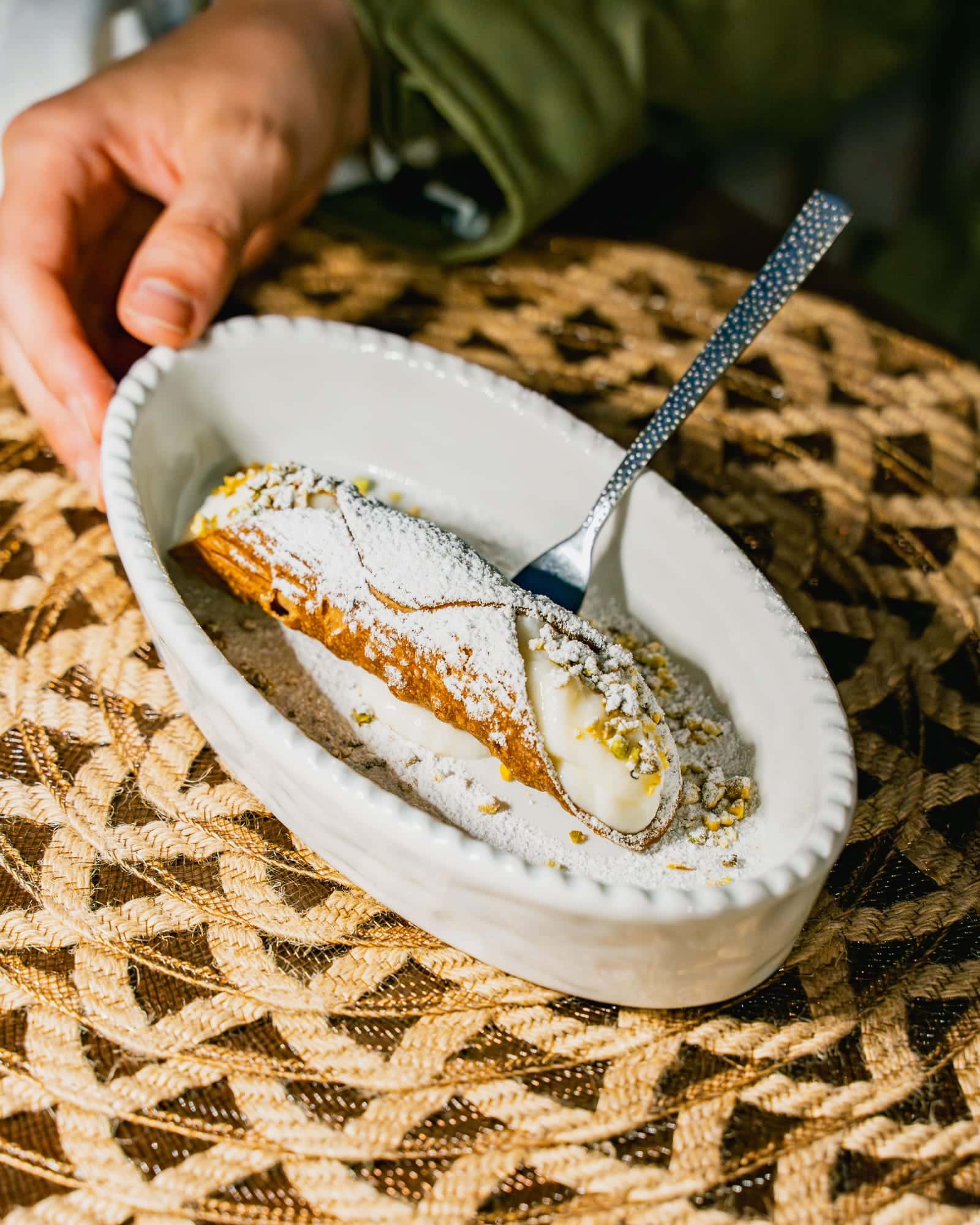
A cannolo is made of just two things: a thin shell, fried until it blisters, and a ricotta cream that tastes of milk. Everything else, the pistachio, the candied peel, the chocolate, is decoration.
The rule that matters most is also the simplest: you fill a cannolo when you are about to eat it. Left to sit, the ricotta softens the shell and the crunch soon goes. That is why, when the estate puts on cannoli on the spot for a party, the shells arrive empty and are filled at the last moment, in front of the guests.
Ingredients
- 250 g 00 flour (or plain flour)
- 25 g caster sugar
- 25 g lard, or soft butter
- 1 egg
- 1 teaspoon unsweetened cocoa powder (about 5 g)
- 1 pinch of salt
- 70 ml dry Marsala
- 1 egg white, to seal the shells
- 1 litre groundnut oil, for frying
- 700 g sheep’s milk ricotta
- 180 g icing sugar, plus extra for dusting
- 70 g dark chocolate chips
- 50 g diced candied orange peel (optional)
- 40 g chopped pistachios
Method
Set the ricotta to drain in a fine sieve, covered, in the fridge for at least two hours: it needs to lose all its whey.
In a bowl, mix the flour, sugar, cocoa and salt. Add the lard and the egg, then the Marsala a little at a time, and knead for about ten minutes until the dough is smooth and firm. Wrap it in cling film and leave it to rest for an hour at room temperature.
Meanwhile push the ricotta through the sieve and work it with the icing sugar using a spatula, not a blender: the cream must stay thick. Stir in the chocolate chips and the candied peel, cover and return it to the fridge.
Roll the dough out very thin, one or two millimetres, with a rolling pin or a pasta machine. Cut out 10 cm discs and roll them a little longer, into ovals.
Wrap each oval around a metal cannoli tube, about 2.5 cm across, so that the edges overlap. Brush egg white only where they overlap and press firmly: if the egg white touches the tube, the shell will stick to it.
Heat the oil to 170-175 °C in a deep pan and fry two or three shells at a time for about two minutes, until deep golden and covered in small blisters. Drain them on kitchen paper.
While they are still warm, hold each shell in a tea towel and gently slide out the tube. Let the shells cool completely before filling them.
Just before serving, spoon the cream into a piping bag with a wide nozzle and fill each shell from both ends. Dip the ends in the chopped pistachios and dust with icing sugar.
Where it comes from
The name comes from the cane: the shells were once wrapped around lengths of cane cut to size, and metal tubes came along much later.
The story told most often starts with an ancient recipe, which some trace back to the Romans, taken up in the Arab period, when sugar cane reached Sicily, and later perfected in a convent near Caltanissetta. The dates are uncertain, Carnival is not: for centuries the cannolo was the sweet of that festival, before it found its way into pastry shops all year round.
The ricotta makes the cannolo
Tradition calls for fresh sheep’s milk ricotta, made that day or the day before. It tastes stronger than cow’s milk ricotta, which still works well and gives a gentler cream: at Basaricò, for instance, the cannolo is made with cow’s milk ricotta. What matters is texture. Wet ricotta makes a runny cream that soaks the shell, so draining it properly is the one step you cannot skip.
Icing sugar dissolves at once and leaves no grains. Caster sugar works too, but then it is stirred into the ricotta the night before and left to dissolve in the fridge. Either way, the sieve is what makes the cream smooth: a blender whips and warms it and tends to turn it runny.
In the shell, lard is the traditional home choice and gives the flakiest result, though butter works well too. Besides its aroma, the Marsala helps the dough blister in the oil: that is what gives the surface its uneven, crunchy look.
Variations
At the ends, instead of pistachio, you will often find a strip of candied orange peel or half a candied cherry. Some people add a pinch of cinnamon or a little grated orange zest to the cream.
The same dough makes bite-sized cannoli: cut 6 cm discs and wrap them around thin tubes. And if a shell breaks, crumble it over a small bowl of ricotta cream: a deconstructed cannolo, and nothing goes to waste.
How to keep them
Empty shells keep for a week in a closed tin, away from damp. The ricotta cream stays good for two days in the fridge, well covered.
A filled cannolo does not keep: eat it straight away, while the shell still crackles. If you are expecting guests, prepare everything ahead and fill the cannoli at the last moment.